



- RZ now priced in between NX and RX hybrids.
- New lineup includes Dyanmic and performance F Sport.
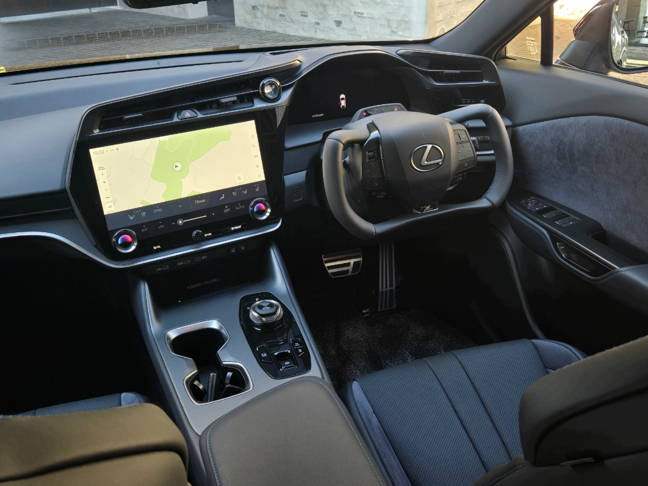
- Yoke steering wheel and steer-by-wire standard on flagship model.
Lexus New Zealand has radically realigned the pricing of its only pure-electric (BEV) model, the RZ. It now sits underneath, rather than above, the RX hybrid range.
The new pricing strategy has been implemented with the launch of the revised RZ lineup, which comprises 500e Dynamic and 550e F Sport models – the latter a high-performance specification not previously offered.
When the original RZ was launched in 2023, the entry-level Core model dovetailed with the flagship $142,900 RX500h F Sport: it was priced at $141,900, with the Dynamic at $151,600.
The updated RZ lineup now starts at "just" (in relative terms) $109,900 for the 500e Dynamic (there’s no longer a base Core version) and rises to $134,900 for the 550e F Sport.
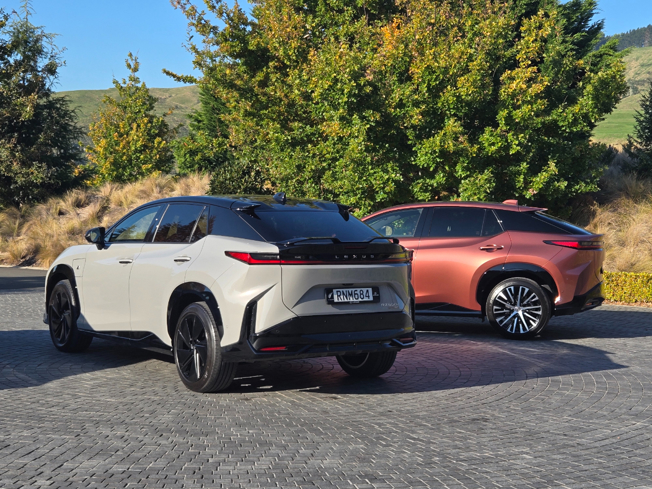
The Dynamic is now only slightly more expensive than the smaller NX350h Limited. But more significantly, the F Sport – a completely new performance model that features Lexus-first technologies such as steer-by-wire (SBW) with a yoke steering wheel and Interactive Manual Drive – is cheaper than the RX350h Limited ($137,500) and a whopping $10k less than the RX500h F Sport ($143,900).
You could argue the dramatic shift is a reflection of the RZ’s modest sales. In the 3 years since launch, the RZ has only accounted for 120 registrations.
Lexus NZ prefers to pitch it as a response to the changing market.
“We’ve made a deliberate strategy here to put it in amongst the SUV lineup,” says Lexus NZ vice president and chief strategy officer Andrew Davis.
“When we launched the car it was kind of treated in isolation. But you’re got to shift with the customer. Because we’ve got a multi-pathway strategy, we want to offer all the different powertrains to customers at accessible price points.
“When you pair [the RZ 550e F Sport] against the RX 500h, which is our performance flagship… that’s what I drive.”
“[The first RZ] was priced high. I think we were all learning within the market dynamics at the same time. This is about balancing to meet the market.
"The market doesn’t seem to be in a position to accept a high-priced BEV”.
Both RZ models can hit 100km/h in less than 5 seconds. The Dynamic makes 280kW, the F Sport 300kW.
The star piece of technology for the new model is SBW, which does not require any physical connection between the steering and front axle, using electronic signals and actuators.
It’s variable ratio, with fewer turns lock-to-lock in city driving than at high speed. Lexus also says the system can filter out unwanted vibration from the road surface without impacting steering feel or responsiveness.
SBW is partnered with a radical-looking “yoke” steering wheel, which showcases the fact that the driver never needs to move hand position from quarter-to-9. Lexus also says it provides clearer vision of the instruments and easier ingress/egress from the car.
It’s standard on the F Sport but can also be optioned on the Dynamic for $10k ($119,900).
Lexus NZ’s aspirations for the new RZ are still pretty modest: 40-50 per year. But Davis says he wouldn’t be surprised if sales were double that, given the new pricing and the stronger uptake of BEVs in the current fuel crisis. The company says it can increase its allocation if the demand is there.